An ocean within a moon. A person within the light.
Step inside another world.
Zencelades invites a person to become a moon. A seated participant inside a soft sphere becomes a living presence among ice, ocean and light.
Inspired by Enceladus, Saturn’s ocean moon, the sculpture brings an intimate human encounter to Love Burn’s SHOWTIME! theme. Friends gather outside; someone inside becomes part of the show. Both viewpoints matter.
The audience makes the show.
The intended experience is a supervised turn inside a softly padded sphere. Projected imagery moves across its skin while people gather around it. Watching from outside is a complete way to participate.
Optional internal cameras could blend a consenting participant’s live image with the moon. That is a prototype goal: capture, mapping, privacy choices and the final optical setup still need to be resolved.
Made for a shared moment
The physical idea is deliberately small and handmade: a moon that looks as though it has landed, with its entrance facing the gap between two legs. The third leg sits behind the sphere. Soft contact surfaces and an open approach are central to the design.
The same triangle also carries the proposed projector arms and camera mounting points. One or two projectors can create an intentional show on selected sides; three heads are an expanded mapping option. Full-sphere coverage has not been demonstrated.
Explore the configurationsA common frame, a clear entrance.
- Sphere studies
- 2.5 m and 3.0 m nominal outside diameter. The actual sphere, entry tunnel, usable interior and manufacturer’s conditions remain to be selected and checked.
- Common holder
- A low metal triangle around a padded circular support ring, with a soft inner floor and a seated participant. Model cutaways reveal the interior; the cutaway is not the actual entrance.
- Lander
- Detachable legs: two beside the entrance, one at the rear. Foot pads, ballast, joints and ground conditions require design and physical validation.
- Aerial alternative
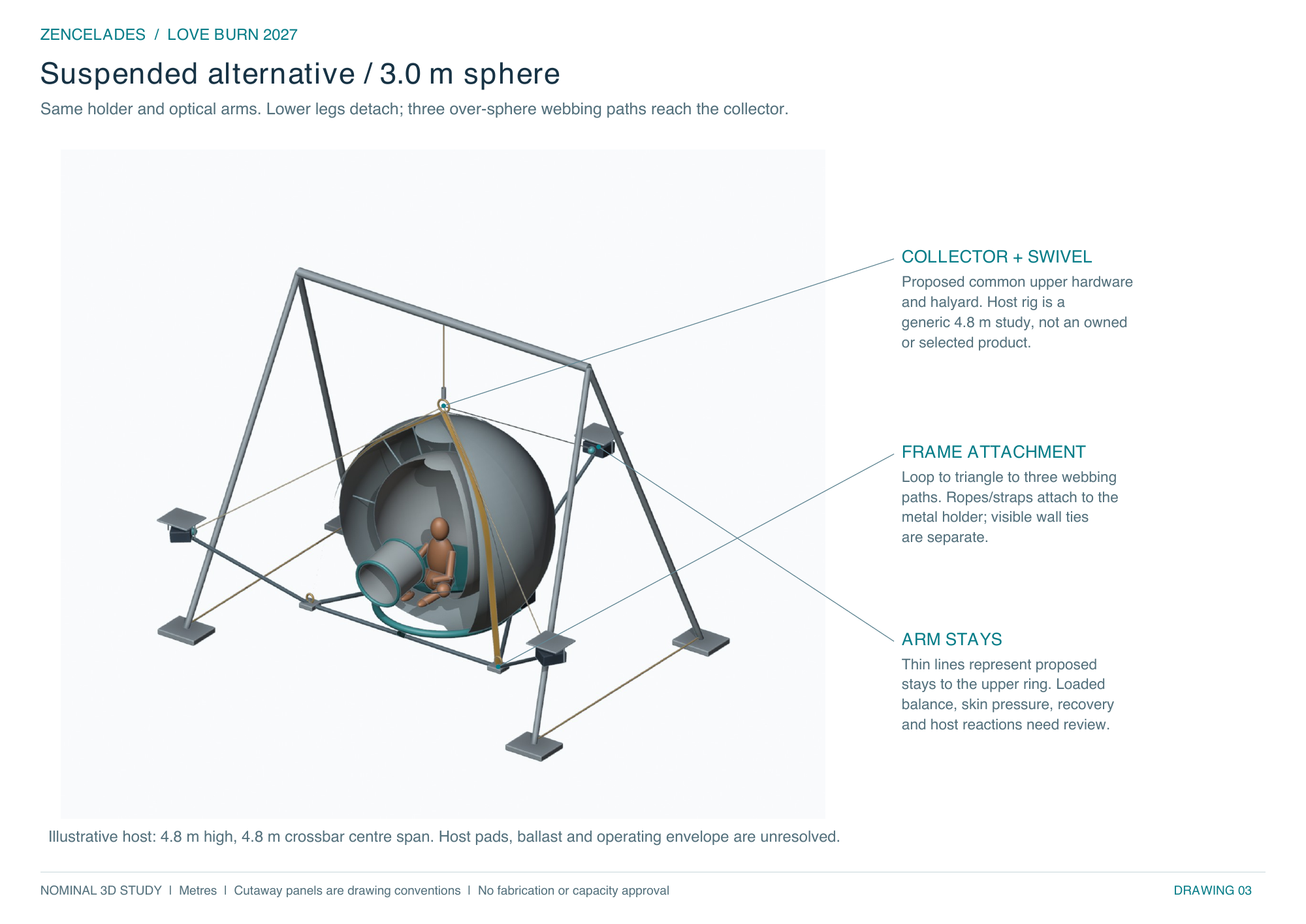
- Over-sphere webbing rises to a collector ring and swivel beneath an external aerial host. Occupied suspension depends on product compatibility, engineered load paths, suitable rigging, host capacity, access and rescue provisions.
- Light and atmosphere
- One, two or three selected projectors, with covers riding on their arms. Andrew’s existing hazer is an external effect behind/below the sphere; its placement and operating clearances still need checking.
These are design studies. A drawing, donor ring or nominal hardware size does not establish a safe working load. Fabrication specifications and occupied operation need qualified review and physical verification.
A $3,000 DIY build.
$3,000 is the total cash ceiling. Grant support, Andrew’s contribution and any fundraiser all contribute to that same total.
The current ground sphere, holder and light allocation is $2,400, with $600 held in reserve. These are planning ceilings, not supplier quotations or evidence that the complete projection and suspension system is funded.
Open the budget and alternativesBuild around what is real
Andrew owns the hazer and a pipe bender and has access to Denhac. Fabrication help, usable reclaimed metal, equipment loans and a suitable aerial host remain commitments to confirm.
Projectors, live cameras and suspension must earn their place in the budget through documented quotes, reallocations or contributions. The studio compares options; an option shown in a model is not a purchase or a promise.
From proposal to a real encounter.
The next work is to select the actual sphere, test its contact with the holder, price the chosen light setup, and resolve the occupied installation with the appropriate specialists and event team. The submission acknowledgment also asks the build team to complete a separate theme-camp application and watch for Ops coordination.